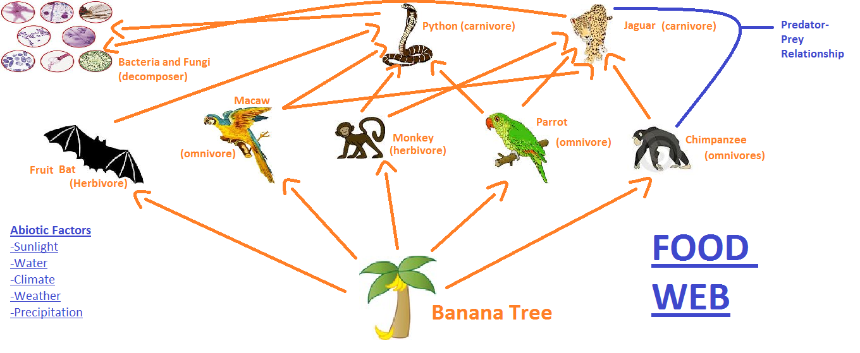
In the food web above the predator- prey relationship is between the chimpanzee and the jaguar. The number of each of these species fluctuates because of one another. When the chimpanzees food supply runs low and part of the species is dying then the jaguar has a limited amount of food now because of that. When the jaguars start dying also because the lack of food with the chimpanzees then the remaining chimpanzees arent being killed and hunted down as much by the jaguars and this pattern goes up and down throughout the predator- prey relationship. When the predator species is low in a predator- prey relationship then that allows the prey's population to increase, when the prey's food is low than the prey suffers and eventually so does its predator.
Invasive species can be really harmful to any environment because the population can grow out of control and cause other species to die because of it. An invasive species in the tropical rainforest is the ash tree. The ash tree is harmful to other trees in the tropical rainforest because the ash tree is very tall and grows past all the other trees on the rainforest floor, this is a problem because this causes the lower trees to get less sun, therefore causing it to decrease growth and the trees dying. The ash tree can't be the only tree in the rainforest because animal species live off of other important trees. As you can see, just with this one invasive specie the whole tropical rainforest biome can be affected by it.
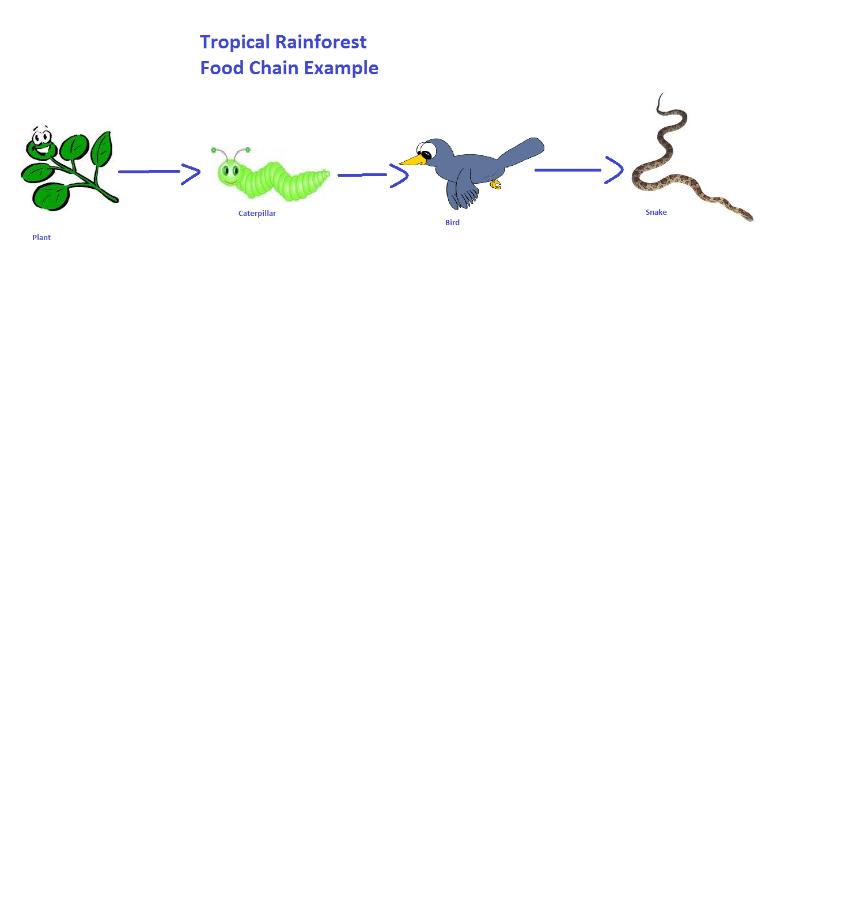
In this food chain below energy is going from the plant to the caterpillar that eats it, to the bird that eats the caterpillar, and lastly to the snake that eats the bird. The direction of the arrows is the way the energy is going. The caterpillar is a herbivore, a plant eating animal, and uses the green plant for energy. The bird in this case is a carnivore, a meat eating animal, and uses the caterpillar for energy. The snake is a carnivore, a meat eating animal also, and uses the bird for energy. This is the way energy travels in a food chain.
Density Dependent Factors Density dependent factors, unlike density independent factors can effect a population no matter what the size of the population is. "Some examples of this are a food supply of a species declining due to population increase or predators hunting their prey in a more specific area because increase in population." Basically density dependent factors are competition, predation, and disease or parisitism. | Density Independent Factors A density- dependent factor can effect an environment and population no matter what size because they usually are human related or natural causes. Some human related density independent factors could include deforestation, or the cutting down of the rainforests' trees. Natural causes could include tropical storms and natural disasters. |
An energy pyramid's purpose is to show energy flow in a food chain and how the amount of energy is decreasing and becoming less available as it goes through each trophic level. In the end, a lot of this energy is lost as heat. If 100% of the energy is available at the first trophic level that amount decreases to 10% after the primary consumers then t o 1% with the secondary consumers and .1% to the tertiary consumers. Energy is lost in each trophic level because every level of consumers uses the energy so less gets passed on once you get to the highest level.